SciMate – Determine Oxidation States via SMILES and Structure
Determine the oxidation states of atoms in a chemical structure. To do this, you can draw the structure and convert it into SMILES notation. Alternatively, you can enter a SMILES notation directly.
The oxidation states will then be calculated and displayed on the structure.
Draw Structure
Annotated Structure (SVG)
List of Oxidation States
Understanding Oxidation States — Introduction & Rules
Oxidation States: Definition
The oxidation state is the formal charge assigned to an atom in a compound, assuming that all bonding electrons belong entirely to the more electronegative bonding partner. It is not a physically measurable value, but rather a computational tool used to describe electron distribution and visualize electron transfers in reactions.
The sum of all oxidation states in a neutral compound is always 0. For polyatomic ions, the sum corresponds to the overall charge of the ion.
Application
Oxidation states are the central tool for analyzing redox reactions. An increase in the oxidation state corresponds to an oxidation (formal electron loss), while a decrease corresponds to a reduction (formal electron gain). This allows redox reactions to be clearly identified, oxidizing and reducing agents to be named, and electron balances to be established – which forms the basis for correctly balancing redox equations.
The Core Principle: Electronegativity
All oxidation states are derived from electronegativity (EN). For every bond, the bonding electrons are assigned entirely to the more electronegative atom. In a bond between identical atoms (e.g., C–C, O–O), the electrons are shared equally – this type of bond contributes 0 to the oxidation state. All rules for F, O, and H follow directly from this principle: they are not independent arbitrary rules, but rather consequences of their respective electronegativities.
Step-by-Step: Determining Oxidation States
You can determine the oxidation states of a compound systematically in four steps:
- oxidationszahlen_schritt1
- Monoatomic ions are directly assigned their ionic charge as their oxidation state: Na⁺ = +I, Cl⁻ = −I, Mg²⁺ = +II.
- Count the bonding electrons for each covalent bond: A single bond (–) contains 2 electrons, a double bond (=) 4 electrons, and a triple bond (≡) 6 electrons. Compare the electronegativities of the atoms involved: all bonding electrons of this bond are assigned entirely to the more electronegative atom. In the case of equal EN (e.g., C–C, O–O, C=C), the electrons are shared equally – this bond contributes 0 to the oxidation state. This principle applies regardless of the bond order.
- Calculate the oxidation state of each atom: Subtract the number of assigned electrons from the number of valence electrons of the neutral atom. If an atom is assigned more electrons than in its neutral state, the oxidation state is negative – if it receives fewer, it is positive.
- Verify using the sum rule: The sum of all oxidation states must equal the overall charge of the compound – 0 for neutral molecules, and equal to the ionic charge for ions. If the sum does not match, there is an error in the electron assignment.
Special Cases
Some compounds require special attention because the EN ratios deviate from expectations. In peroxides (e.g., H₂O₂), an O–O bond is present: since both oxygen atoms have the same EN, they share the bonding electrons of this bond equally. Thus, each O is only fully assigned the electrons from the O–H bond – the oxidation state is therefore −I instead of the usual −II. The same principle applies to superoxides (e.g., KO₂) and O–O bonds in organic peroxides. In compounds with fluorine (e.g., OF₂), fluorine is more electronegative than oxygen – oxygen is assigned the oxidation state +II there. In metal hydrides (e.g., NaH, CaH₂), the metal is less electronegative than hydrogen: the bonding electrons of the M–H bond are fully assigned to H, meaning hydrogen carries the oxidation state −I.
Calculation Examples
The following examples cover typical compound classes – from simple salts to inorganic molecules and organic compounds:
Sodium chloride (NaCl) – Ionic compound
Na is significantly less electronegative than Cl: the bonding electron pair is assigned entirely to Cl. Na⁺ = +I, Cl⁻ = −I. Sum: (+I) + (−I) = 0.
+INa −ICl
Water (H₂O) – Covalent compound
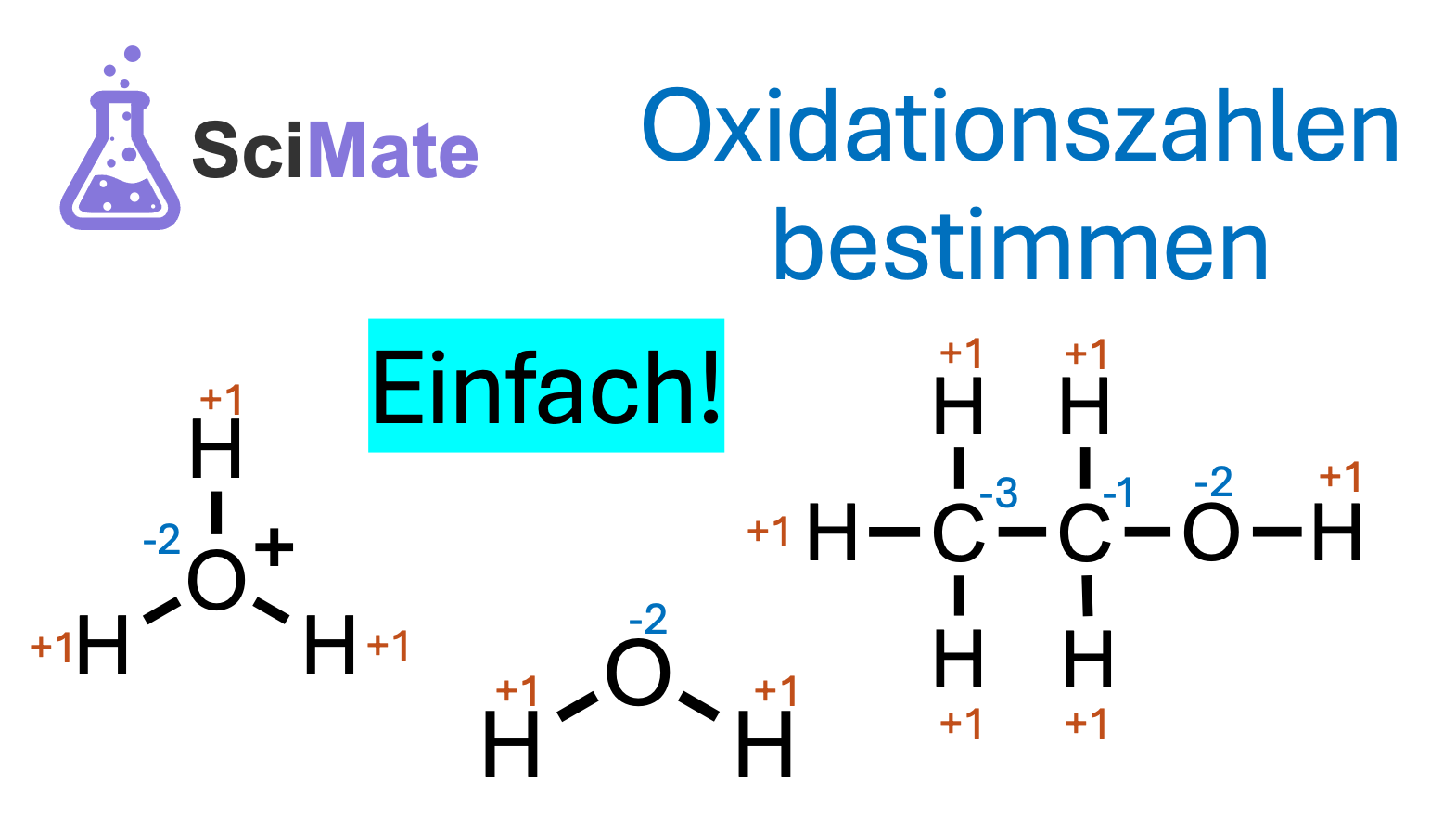
O is more electronegative than H: both bonding electron pairs are fully assigned to O, while the H atoms receive none. Sum rule: O = −II, H = +I. Check: (−II) + 2·(+I) = 0 ✓
+IH 2 −IIO
Hydrogen peroxide (H₂O₂) – Peroxide special case
Each O forms a bond to H and one O–O bond. The O–H bonding electrons are assigned to O (O is more electronegative). The O–O bonding electrons are shared (equal EN). Each O is therefore assigned 1·2 + ½·2 = 3 electrons; O has 6 valence electrons → OxS = 6 − (6+1) = −I. H = +I. Sum: 2·(+I) + 2·(−I) = 0 ✓
+IH −IO −IO +IH
Sulfate ion (SO₄²⁻) – Polyatomic ion
O is more electronegative than S: all bonding electrons are assigned to O. O = −II. Sum rule: S + 4·(−II) = −2 → S = +VI. Check: (+VI) + 4·(−II) = −2 ✓
[+VIS −IIO 4]2−
Carbon dioxide (CO₂) – Double bonds
CO₂ has two C=O double bonds (4 electrons each). O is more electronegative than C: all 4 electrons of each double bond are assigned to O. Sum rule: C + 2·(−II) = 0 → C = +IV. Check: (+IV) + 2·(−II) = 0 ✓
+IVC −IIO 2
Methane (CH₄) – Organic compound
C is more electronegative than H: all four C–H bonding electron pairs are assigned to C. C receives 4·2 = 8 electrons, but has 4 valence electrons → OxS = 4 − 8 = −IV. Check: (−IV) + 4·(+I) = 0 ✓
−IVC +IH 4
Ethanol (C₂H₅OH) – Organic compound with oxygen
Ethanol has two C atoms in different chemical environments. Methyl-C (CH₃–): 3 C–H bonds (C is more electronegative, 2 e⁻ each → 6 e⁻ assigned) + 1 C–C bond (equal EN, 1 e⁻ shared). C receives 6 + 1 = 7 electrons; 4 valence electrons → OxS = 4 − 7 = −III. Methylene-C (–CH₂OH): 2 C–H bonds (4 e⁻) + 1 C–C bond (1 e⁻ shared) + 1 C–O bond (O is more electronegative, 0 e⁻). C receives 4 + 1 = 5 electrons → OxS = 4 − 5 = −I. Check: (−III) + (−I) + 6·(+I) + (−II) = 0 ✓
−IIIC +IH 3 −IC +IH 2 −IIO +IH