Concentration Calculator
Calculate molar concentration or mass concentration as well as amount of substance, mass, molar mass, and volume. The calculator automatically determines c, n, m, M, or V.
Concentration Calculator
Would you like to dilute a solution or mix two solutions instead? To the Dilution & Mixing Calculator.
How to Calculate the Concentration of a Solution
What is Molar Concentration?
Imagine you are cooking pasta and adding salt to the water. How salty is the water now? This is exactly what concentration describes: It tells us how much of a substance is contained in a solution, relative to a specific volume.
If you add more salt to the same volume of water, the solution becomes more concentrated. If you add less, it is more diluted. To describe this mathematically, we use the molar concentration c.
Key Variables
Molar Concentration (c)
Indicates how many moles of a dissolved substance are contained per liter of solution. Unit: mol/l, also referred to as 'molar' (M).
Amount of Substance (n)
The quantity of a substance, specified in moles – regardless of what substance it is.
Volume (V)
The volume of the entire solution (not just the solvent), usually specified in liters.
Mass and Molar Mass (m & M)
If the amount of substance is not directly known, it can be calculated using the mass m of the dissolved substance and its molar mass M.
If you dissolve 1 mole of salt in 1 liter of water, you have a concentration of 1 mole per liter. If you dissolve 2 moles of salt in the same volume, the concentration doubles to 2 mol/l. Therefore, more substance in the same volume means a higher concentration.
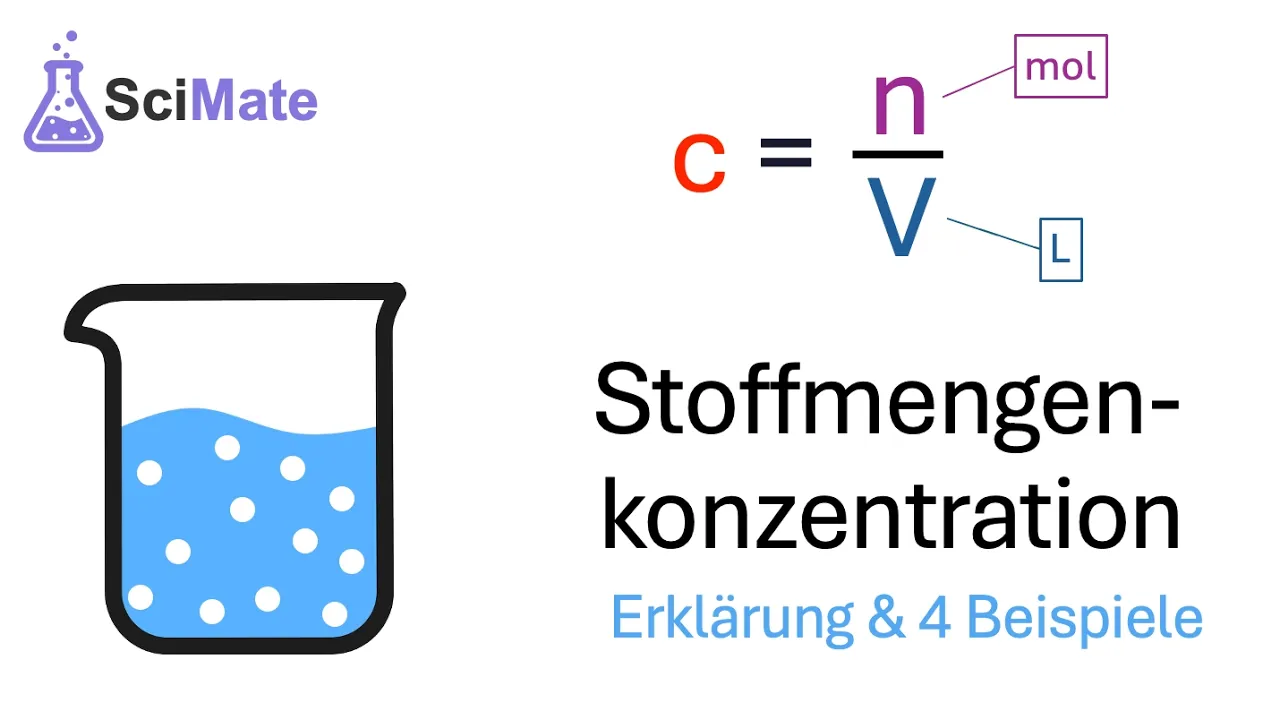
The Formula: c = n / V
Molar concentration is calculated by dividing the amount of substance n by the volume V of the solution.
Basic Formula
c = n / V
The unit is derived directly from moles divided by liters, which is mol/l. This unit is also called 'molar' and is abbreviated with a capital M (e.g., 1 mol/l = 1 M).
Rearranging the Formula for n, c, or V
Depending on which variable you are looking for, the formula c = n / V can be rearranged for any of the three variables. The easiest way to remember this is by using the formula triangle.
Cover the desired variable with your finger: If the remaining two are next to each other, they are multiplied; if one is above the other, they are divided.
Calculating the Amount of Substance (solving for n)
n = c · V
If you want to find n, multiply the concentration c by the volume V.
Calculating the Concentration (solving for c)
c = n / V
If you want to find c, divide the amount of substance n by the volume V.
Calculating the Volume (solving for V)
V = n / c
If you want to find V, divide the amount of substance n by the concentration c.
Pay Attention to the Units
Always convert volume specifications into liters first (e.g., 500 ml = 0.5 l) before entering them into the formula. This is the only way to ensure the final unit of mol/l is correct.
Conversion Between Mass and Amount of Substance
Often, it is not the amount of substance but the mass of the dissolved substance that is known – for example, because you have weighed something out. The molar mass M can be used to convert between mass and amount of substance.
Basic Formula
m = n · M
M is the molar mass of a substance (unit g/mol) and can be calculated from the atomic masses of the elements involved, e.g., using a chemical formula like NaCl or C₆H₁₂O₆.
This formula can also be rearranged
Just like with c = n / V, the formula triangle also applies here to calculate m, n, or M specifically.
Cover the variable you are looking for: m at the top, n and M next to each other at the bottom – adjacent variables are multiplied, stacked variables are divided.
By combining both formulas, the concentration can also be calculated directly from the mass, without having to calculate the amount of substance separately first:
$$c = \dfrac{m}{M \cdot V}$$
This calculator performs this conversion automatically – you can enter either n or m, as long as the molar mass M is known (either entered directly or calculated via the chemical formula).
Calculation Examples
The best way to understand the formula is through concrete problems. The following examples are taken from our YouTube video on molar concentration.
Example 1 – Calculating Concentration
Calculate the molar concentration of saltwater when 0.2 mol of NaCl is added to 500 ml of water.
Given
n = 0.2 mol, V = 500 ml = 0.5 l
Required
c = ?
Solution
$$ c = \dfrac{n}{V} $$
$$ c = \dfrac{0.2\ \text{mol}}{0.5\ \text{l}} $$
c = 0.4 mol/l
Example 2 – Calculating Volume
An aqueous solution of 0.05 mol of sugar with a concentration of 0.25 mol/l is required. What volume of water is needed?
Given
n = 0.05 mol, c = 0.25 mol/l
Required
V = ?
Solution
$$ V = \dfrac{n}{c} $$
$$ V = \dfrac{0.05\ \text{mol}}{0.25\ \frac{\text{mol}}{\text{l}}} $$
V = 0.2 l = 200 ml
Example 3 – Calculating Concentration from Mass
For pasta water, 5.85 g of NaCl is dissolved in 1.0 l of water. Calculate the molar concentration.
Given
m(NaCl) = 5.85 g, V = 1.0 l, M(NaCl) = 23 + 35.5 = 58.5 g/mol
Step 1 – Calculate the amount of substance
$$ n = \dfrac{m}{M} = \dfrac{5.85\ \text{g}}{58.5\ \frac{\text{g}}{\text{mol}}} = 0.1\ \text{mol} $$
Step 2 – Calculate the concentration
$$ c = \dfrac{n}{V} $$
$$ c = \dfrac{0.1\ \text{mol}}{1.0\ \text{l}} $$
c(NaCl) = 0.1 mol/l
Example 4 – Calculating Volume from Particle Number
In a 6-molar glucose solution, there are 9.03 · 10²³ molecules. Calculate the volume of the solution.
Given
c = 6 M = 6 mol/l, N = 9.03 · 10²³, N_A = 6.022 · 10²³ mol⁻¹
Step 1 – Calculate the amount of substance from the number of particles
$$ n = \dfrac{N}{N_A} $$
$$ n = \dfrac{9.03 \cdot 10^{23}}{6.022 \cdot 10^{23}\ \text{mol}^{-1}} = 1.5\ \text{mol} $$
V = n / c = 1.5 mol / 6 mol/l = 0.25 l = 250 ml
Tips and Common Mistakes
Common Mistakes when Calculating Concentration
1. Volume not converted to liters
If the volume is given in ml, it must first be converted to liters before substituting it into mol/l formulas (500 ml = 0.5 l). Otherwise, the result will be off by a factor of 1000.
2. Confusing molar concentration and mass concentration
c = n/V (mol/l) is not the same as the mass concentration m/V (g/l). Without the molar mass M, these two quantities cannot be directly converted into one another.
3. Incorrect calculation of molar mass
For compound substances, the atomic masses of all elements must be added according to their quantity in the chemical formula (e.g., NaCl: 23 + 35.5 = 58.5 g/mol). Forgetting a single element or miscounting it will lead to incorrect results in all subsequent calculations.
4. Volume of the solution instead of volume of the solvent
The formula requires the volume of the finished solution, not just the volume of the added water. In most problems, this is approximately the same, but for highly concentrated solutions, it can make a difference.
The fastest way to proceed
Always write down what is given and what you need to find first. Then check if you can use c = n/V directly or if you first need to calculate n from m and M (or from the number of particles N).
Where do you encounter concentration in everyday life and in the laboratory?
Molar concentration is one of the most important quantities in chemistry and appears in many areas:
- Preparation of standard solutions in chemistry class and in the laboratory
- Dosage of medications and infusion solutions in medicine
- Determination of salt, sugar, or alcohol content in food and beverages
- Water analysis, e.g., measuring the concentration of pollutants or nutrients