Stoichiometry Calculator
Calculate mass (m), amount of substance (n), and molar mass (M) quickly and easily
Enter Values
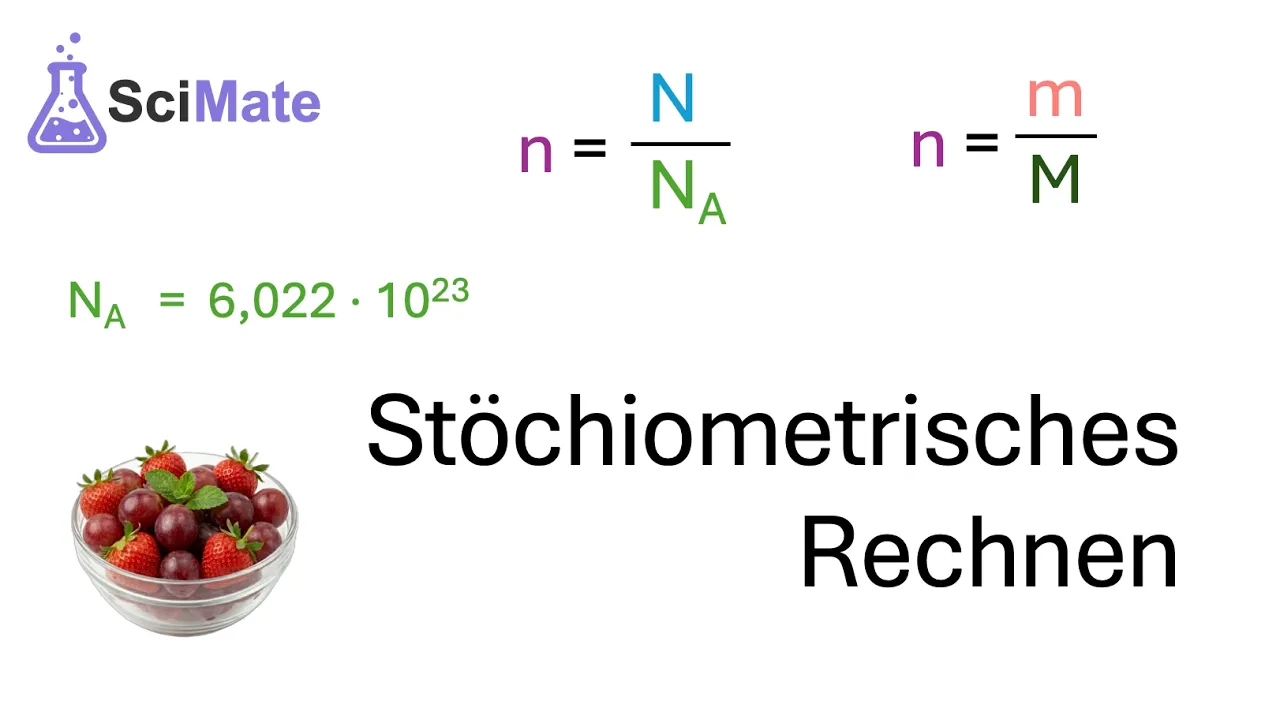
Explanation: Understanding Stoichiometric Calculations
Part 1: Basics – What Do m, n, M, N, and $N_A$ Mean?
How many grams of water do I need to produce 2 moles of H₂O? How many moles are in 100 g of table salt? And how many individual molecules are actually in there? Stoichiometry answers these questions using two simple formulas: m = n · M and N = n · $N_A$.
In chemistry, we constantly convert back and forth between mass (in grams), amount of substance (in moles), molar mass (in g/mol), and the number of particles. These variables are directly related and form the basis of almost all quantitative calculations in chemistry – from simple classroom problems to complex reaction setups in the laboratory.
Overview of Key Variables
Mass (m)
Mass m indicates how heavy a substance is. It is measured in grams (g). Example: A glass of water weighs about 200 g. Mass can be measured directly using a scale.
Amount of Substance (n)
The amount of substance n indicates how many particles (atoms, molecules, ions) are present in a sample – but not as an absolute number, rather in "packets" of 6.022 · 10²³ particles each. One such packet is called 1 mole. The unit is mol. Example: 1 mole of water contains approximately 6 · 10²³ H₂O molecules.
Molar Mass (M)
Molar mass M indicates how heavy 1 mole of a substance is. It is expressed in g/mol. Example: 1 mole of water (H₂O) has a molar mass of 18.02 g/mol – this means that 1 mole of water weighs exactly 18.02 g. You can calculate the molar mass from the periodic table (see also our molar mass calculator).
Number of Particles (N) & Avogadro Constant (NA)
The number of particles N represents the actual, absolute count of atoms, molecules, or ions in a sample. It is linked to the amount of substance through the Avogadro constant $N_A$ = 6.022 · 10²³ mol⁻¹: 1 mole of a substance always contains exactly $N_A$ particles. Thus, $N_A$ serves as the conversion factor between moles and the number of individual particles.
All of these variables are linked by two formulas: m = n · M connects mass, amount of substance, and molar mass. N = n · $N_A$ connects the number of particles, amount of substance, and the Avogadro constant. If you know enough variables, you can calculate everything using these two formulas.
Part 2: The First Formula – m = n · M
The first central formula of stoichiometry connects mass, amount of substance, and molar mass:
Fundamental Formula of Stoichiometry
m = n · M
This formula states: the mass of a substance equals the amount of substance multiplied by its molar mass. In other words: the more moles you have (n) and the heavier 1 mole is (M), the greater the total mass (m).
Rearranging the Formula – Depending on What You Are Looking For
Depending on which variable you need to calculate, you must rearrange the formula. The formula triangle can help you: cover up the variable you want to find – what remains is the calculation rule.
Formula triangle: Cover the variable you are looking for, and the rest shows you the formula.
Calculating Mass (m = n · M)
m = n · M
If you know the amount of substance (n) and the molar mass (M), you can calculate the mass (m) by multiplying the two.
Calculating Amount of Substance (n = m / M)
n = m / M
If you know the mass (m) and the molar mass (M), you divide the mass by the molar mass to get the amount of substance (n).
Calculating Molar Mass (M = m / n)
M = m / n
If you know the mass (m) and the amount of substance (n), you divide the mass by the amount of substance to calculate the molar mass (M).
Always pay attention to units!
Mass m → always in grams (g) | Amount of substance n → always in moles (mol) | Molar mass M → always in g/mol. Incorrect units almost always lead to wrong results. For example, if the mass is given in kilograms, you must first convert it to grams (1 kg = 1000 g).
Part 3: The Second Formula – N = n · $N_A$
Along with the mass formula, there is a second important formula that connects the amount of substance with the actual number of particles. It utilizes the Avogadro constant $N_A$:
Avogadro Formula
N = n · NA
$N_A$ = 6.022 · 10²³ mol⁻¹ (Avogadro Constant)
This formula states: the number of particles N equals the amount of substance n multiplied by the Avogadro constant $N_A$. Since $N_A$ is always known (it is a physical constant), you only need one of the variables N or n – the other can be calculated immediately.
Rearranging the Formula
The same applies here: the formula triangle shows you which rearrangement you need. Simply cover the variable you want to find.
Formula triangle: N on top, n and $N_A$ on the bottom.
Calculating Number of Particles (N = n · $N_A$)
N = n · NA
If you know the amount of substance (n), you multiply it by the Avogadro constant to obtain the total number of particles (N).
Calculating Amount of Substance (n = N / $N_A$)
n = N / NA
If you know the number of particles (N), you divide it by the Avogadro constant to obtain the amount of substance (n).
Determining the Avogadro Constant ($N_A$ = N / n)
NA = N / n
This rearrangement is rarely needed – it yields the Avogadro constant if N and n are known. In practice, $N_A$ is always given as a known constant.
Part 4: Application Examples – Step by Step
The following examples show you how to apply the formulas in different situations – from simple problems using a single formula to combined problems where you need both formulas one after the other.
Example 1: Calculating Amount of Substance from Mass (Water)
You have 10 g of water (H₂O) and want to know how many moles that is.
Given:
Mass m = 10 g | Molar mass M = 18.02 g/mol (water)
Required:
Amount of substance n
Solution:
Formula: n = m / M
n = 10 g / 18.02 g/mol = 0.555 mol
Result: n ≈ 0.56 mol
Example 2: Calculating Mass from Amount of Substance (Carbon Dioxide)
You want to know how many grams 2 moles of carbon dioxide (CO₂) weigh.
Given:
Amount of substance n = 2 mol | Molar mass M = 44.01 g/mol (CO₂)
Required:
Mass m
Solution:
Formula: m = n · M
m = 2 mol · 44.01 g/mol = 88.02 g
Result: m = 88.02 g
Example 3: Calculating Molar Mass from Mass and Amount of Substance
You have 58.44 g of a substance and know that it is exactly 1 mole. What is its molar mass?
Given:
Mass m = 58.44 g | Amount of substance n = 1 mol
Required:
Molar mass M
Solution:
Formula: M = m / n
M = 58.44 g / 1 mol = 58.44 g/mol
Result: M = 58.44 g/mol (This is sodium chloride, NaCl)
Example 4: Calculating Amount of Substance with Chemical Formula (Glucose)
You have 90 g of glucose (C₆H₁₂O₆) and want to calculate the amount of substance. The molar mass is not directly given – you must first calculate it from the chemical formula.
Given:
Mass m = 90 g | Chemical formula: C₆H₁₂O₆
Step 1 – Calculate molar mass:
M(C₆H₁₂O₆) = 6 · 12.01 + 12 · 1.01 + 6 · 16.00 = 72.06 + 12.12 + 96.00 = 180.18 g/mol
Step 2 – Calculate amount of substance:
Formula: n = m / M
n = 90 g / 180.18 g/mol = 0.4995 mol
Result: n ≈ 0.50 mol
Example 5: Calculating Number of Particles from Amount of Substance (Helium)
How many helium atoms (He) are contained in 2.0 mol of helium?
Given:
Amount of substance n = 2.0 mol | Avogadro constant $N_A$ = 6.022 · 10²³ mol⁻¹
Required:
Number of particles N
Solution:
Formula: N = n · $N_A$
N = 2.0 mol · 6.022 · 10²³ mol⁻¹ = 1.2044 · 10²⁴
Result: N = 1.2044 · 10²⁴ atoms
Example 6 (Combined): Calculating Number of Particles from Mass (CO₂)
How many molecules are contained in 44 g of carbon dioxide (CO₂)?
Both formulas are required here: First, mass → amount of substance (m = n · M rearranged), then amount of substance → number of particles (N = n · $N_A$).
Given:
Mass m = 44 g | Molar mass M(CO₂) = 44 g/mol | $N_A$ = 6.022 · 10²³ mol⁻¹
Required:
Number of particles N
Step 1 – Calculate amount of substance (n = m / M):
Formula: n = m / M
n = 44 g / 44 g/mol = 1.0 mol
Intermediate result: n = 1.0 mol
Step 2 – Calculate number of particles (N = n · $N_A$):
Formula: N = n · $N_A$
N = 1.0 mol · 6.022 · 10²³ mol⁻¹ = 6.022 · 10²³
Result: N = 6.022 · 10²³ molecules – this is exactly 1 mole, not a coincidence!
Example 7 (Combined): Calculating Mass from Number of Particles (Nitrogen)
A sample contains 3.01 · 10²³ molecules of nitrogen (N₂). What is the mass of this sample?
Here too, both formulas are required: First, number of particles → amount of substance (N = n · $N_A$ rearranged), then amount of substance → mass (m = n · M).
Given:
Number of particles N = 3.01 · 10²³ | $N_A$ = 6.022 · 10²³ mol⁻¹ | Molar mass M(N₂) = 28 g/mol
Required:
Mass m
Step 1 – Calculate amount of substance (n = N / $N_A$):
Formula: n = N / $N_A$
n = (3.01 · 10²³) / (6.022 · 10²³ mol⁻¹) = 0.5 mol
Intermediate result: n = 0.5 mol
Step 2 – Calculate mass (m = n · M):
Formula: m = n · M
m = 0.5 mol · 28 g/mol = 14 g
Result: m = 14 g
Part 5: Tips, Common Mistakes & Applications
Common Mistakes – And How to Avoid Them
Mistake 1: Incorrect Units
The most common source of error! Always make sure that m is in grams, n is in moles, and M is in g/mol. If the mass is given in kilograms or milligrams, convert it to grams first. If you enter the molar mass in kg/mol, the result will be incorrect.
Mistake 2: Incorrectly Rearranged Formula
If you are looking for n, you cannot simply calculate n = M / m – that is incorrect! The correct rearrangement is n = m / M. The formula triangle helps you find the correct order.
Mistake 3: Incorrectly Calculated Molar Mass
For complex molecules like C₆H₁₂O₆, you must multiply the count of each atom by its molar mass and then add everything together. Do not forget to account for the subscripts (small numbers on the bottom right) as well! Use our molar mass calculator if you are unsure.
Mistake 4: Approaching Combined Problems Incorrectly
When mass and particle count are linked, there is no direct formula – you always need two steps using the amount of substance n as an intermediate variable. Step 1: Calculate n with the first formula. Step 2: Calculate the required variable with the second formula. The amount of substance n serves as the link between both formulas.
Solution Strategy for Every Problem
1. Read the problem carefully – which variables are given (m, n, M, N)? | 2. Which variable is required? | 3. Is one formula enough, or do you need two steps using n? | 4. Choose the appropriate formula rearrangement from the formula triangle. | 5. Insert the values with the correct units. | 6. Calculate and check if the result makes sense.
Where Do You Need This in Practice?
Stoichiometric calculations are not just school material – they are the foundation for many practical applications:
- In the laboratory: If you want to prepare a solution with a specific concentration, you must calculate how many grams of substance you need to weigh out.
- In industry: In chemical reactions, you must calculate the exact quantities of the starting materials to avoid any waste.
- In medicine: Medications are often specified in moles per liter (concentration) – to calculate the correct dosage in grams, you need the formula m = n · M.
- In daily life: For instance, if you want to dose baking powder or citric acid and the specifications are in moles instead of grams, this formula will help you out.