Redox Reactions
Oxidation, reduction, and balancing redox equations – explained simply
Balance Redox Equation
Redox Reaction Result
Explanation: Understanding Redox Reactions From the Ground Up
Part 1: Basics – What Are Redox Reactions?
Redox reactions (short for reduction-oxidation reactions) are among the most important reaction types in chemistry. We encounter them everywhere: in the rusting of iron, the burning of wood, in batteries, and even in our own bodies during metabolism. What makes redox reactions special is that electrons are always transferred from one substance to another.
Oxidation = Electron Loss
A substance is oxidized when it loses electrons. Its oxidation state increases in the process.
Reduction = Electron Gain
A substance is reduced when it gains electrons. Its oxidation state decreases in the process.
Remember: Oxidation and reduction always occur simultaneously!
What one substance loses, another gains. There is no oxidation without reduction – and vice-versa. Mnemonic: OIL RIG – Oxidation Is Loss (of electrons), Reduction Is Gain (of electrons).
The substance that loses electrons (is oxidized) is called the reducing agent – it enables the reduction of the other. The substance that gains electrons (is reduced) is called the oxidizing agent – it enables the oxidation of the other.
Oxidation States – The Essential Tool
Oxidation states (OS) are formal charges that we assign to atoms in a compound. They help us recognize whether a redox reaction is taking place and who is losing or gaining electrons. The following rules apply:
- Pure elements always have an oxidation state of 0 (e.g., Na, Cl₂, O₂, Al).
- Simple ions have an oxidation state equal to their charge (e.g., Na⁺ → +1, Cl⁻ → −1, Mg²⁺ → +2).
- Oxygen almost always has −2 in compounds (exception: peroxides like H₂O₂ → −1).
- Hydrogen almost always has +1 in compounds (exception: metal hydrides like NaH → −1).
- The sum of all oxidation states equals the overall charge: 0 for neutral molecules, and the respective ionic charge for ions.
Example 1: Formation of Sodium Chloride (NaCl)
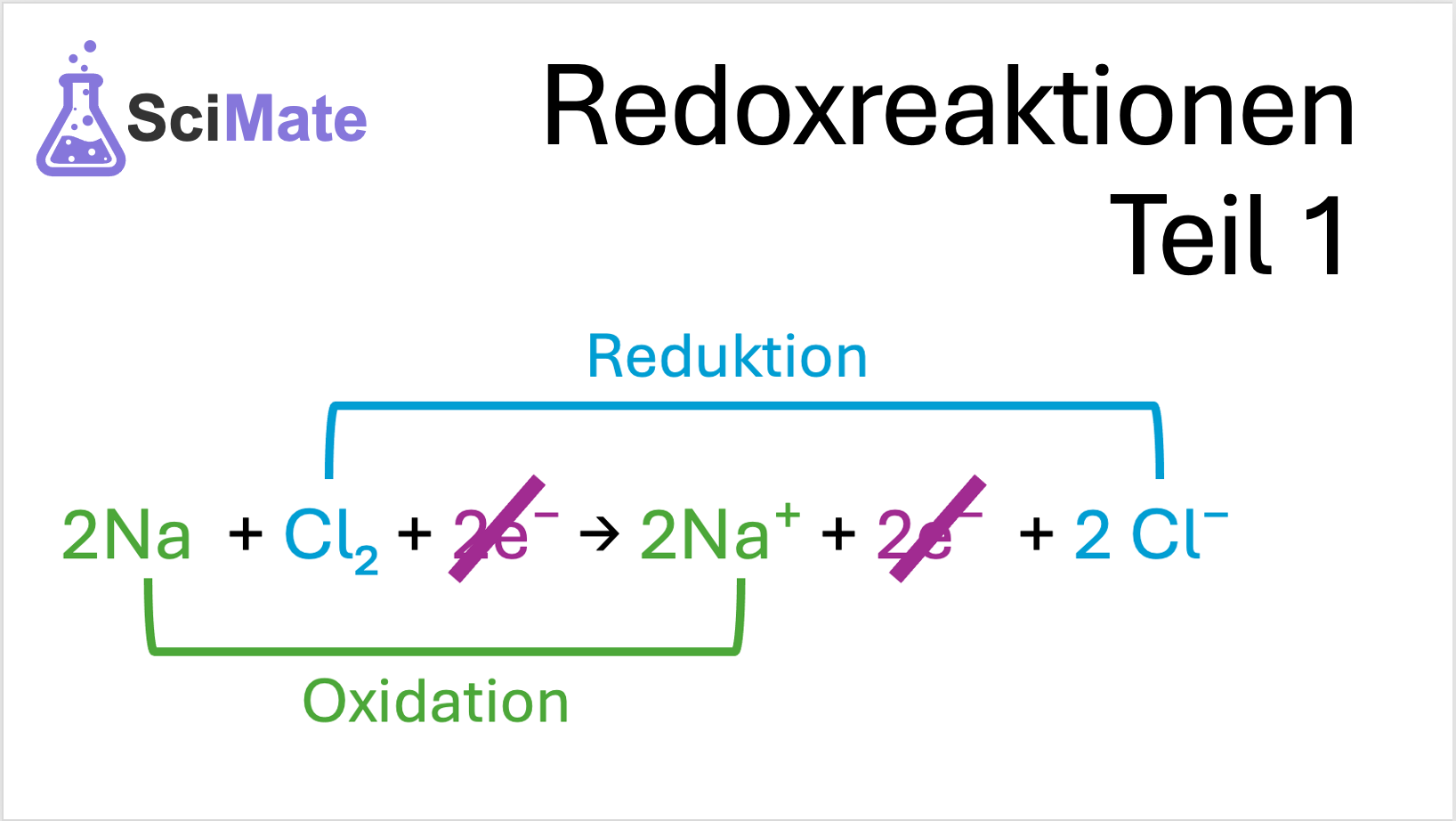
Sodium reacts with chlorine gas to form sodium chloride (table salt). The red numbers above the elements show their respective oxidation states:
Na: 0 → +1 (Oxidation: each Na atom loses 1 electron)
Cl: 0 → −1 (Reduction: each Cl atom gains 1 electron)
Sodium is the reducing agent (loses e⁻), chlorine is the oxidizing agent (gains e⁻). 2 Na atoms each lose 1 e⁻ = 2 e⁻. The Cl₂ molecule gains these 2 e⁻ (1 e⁻ per Cl atom). The balance is complete.
Example 2: Formation of Magnesium Chloride (MgCl₂)
Similar to sodium, magnesium reacts with chlorine gas. Since magnesium is divalent (loses 2 electrons), two chlorine atoms are required, each gaining 1 electron:
Mg: 0 → +2 (Oxidation: the Mg atom loses 2 electrons)
Cl: 0 → −1 (Reduction: each Cl atom gains 1 electron, 2 e⁻ in total)
Mg loses a total of 2 electrons – exactly as many as the two chlorine atoms gain. This balance of transferred electrons is the fundamental principle when balancing any redox equation.
Part 2: Balancing Simple Redox Equations
Now that you know the basics, it's time to balance redox equations. The goal is always the same: the equation must be balanced both in terms of mass (equal number of atoms on both sides) and charge (all transferred electrons are completely gained). We use the half-reaction method for this.
Procedure: Half-Reaction Method (Non-Aqueous)
- Determine the oxidation states of all elements and highlight the changes.
- Write down the half-reactions and balance the charges: write e⁻ on the appropriate side for each electron lost or gained.
- Balance the electrons: multiply both half-reactions by whole-number factors so that the number of lost and gained electrons is equal – determine the least common multiple (LCM) of the electron counts.
- Combine: add both half-reactions together and cancel out the electrons on both sides.
Example: Combustion of Aluminum (Al + O₂ → Al₂O₃)
Aluminum burns in air to form aluminum oxide. The unbalanced equation is: Al + O₂ → Al₂O₃. We balance it step-by-step:
Determine the oxidation states of all elements and highlight the changes.
Both starting materials are pure elements (OS = 0). In the product Al₂O₃, O has the OS −2 (rule: O is almost always −2). For the sum to equal 0: 2·(+3) + 3·(−2) = 0, meaning Al has the OS +3.
Write down the half-reactions and balance the charges: write e⁻ on the appropriate side for each electron lost or gained.
We write a separate half-reaction for each change and balance the charges with electrons:
Oxidation (Al): Al → Al³⁺ + 3 e⁻
Al goes from 0 to +3: the difference of 3 gives the number of electrons lost.
Reduction (O₂): O₂ + 4 e⁻ → 2 O²⁻
O goes from 0 to −2 per atom: −2 × 2 atoms = 4 electrons gained per O₂ molecule.
Balance the electrons: multiply both half-reactions by whole-number factors so that the number of lost and gained electrons is equal – determine the least common multiple (LCM) of the electron counts.
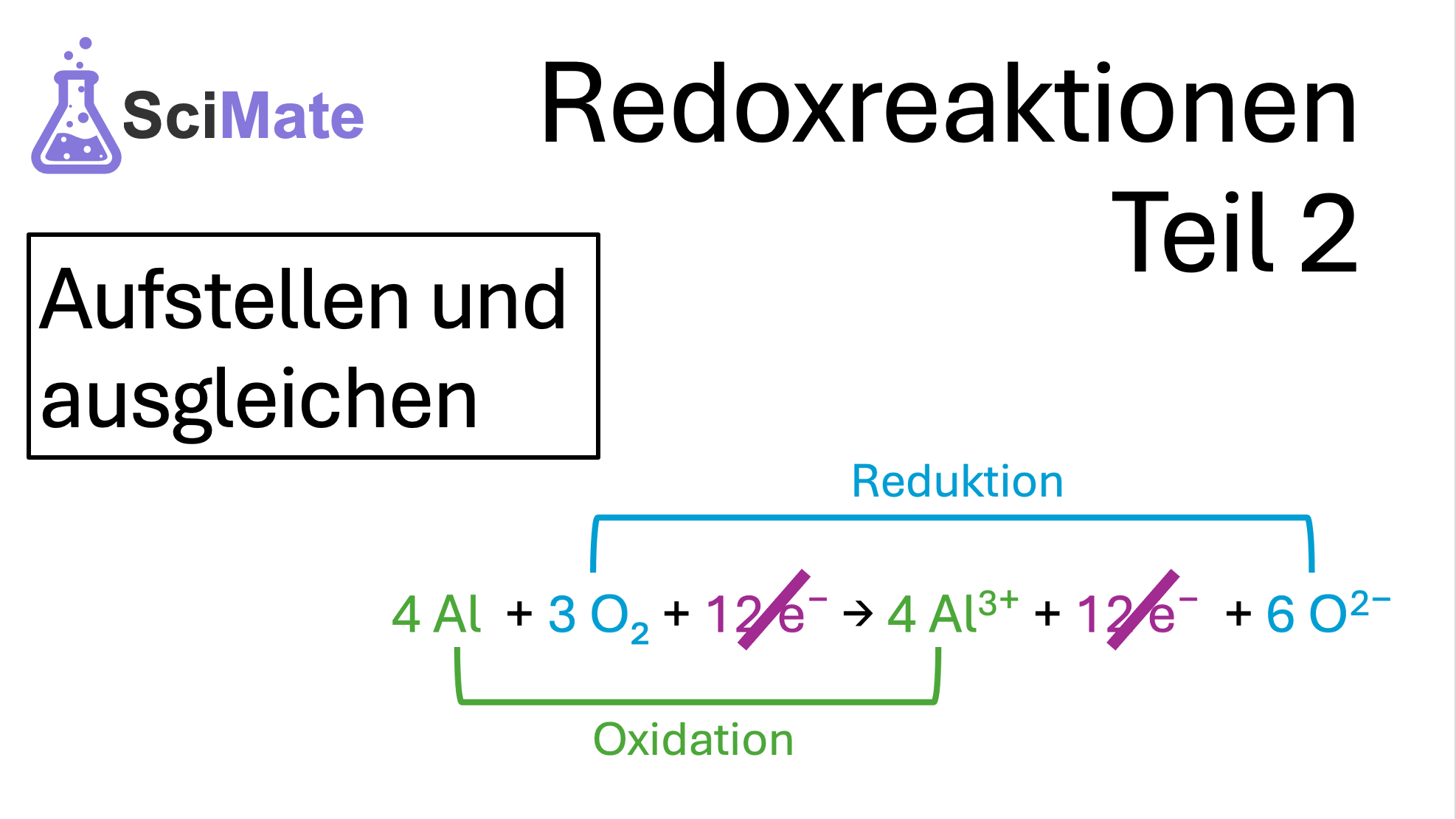
Al loses 3 e⁻, O₂ gains 4 e⁻. The least common multiple (LCM) of 3 and 4 is 12. Therefore, we multiply the oxidation half-reaction by 4 and the reduction half-reaction by 3:
4 · (Al → Al³⁺ + 3 e⁻) → 4 Al → 4 Al³⁺ + 12 e⁻
3 · (O₂ + 4 e⁻ → 2 O²⁻) → 3 O₂ + 12 e⁻ → 6 O²⁻
Combine: add both half-reactions together and cancel out the electrons on both sides.
4 Al + 3 O₂ → 2 Al₂O₃
Check: 4 Al left and right ✓ | 6 O left (3 O₂) and 6 O right (2 Al₂O₃) ✓ | Electrons completely cancelled out ✓
Part 3: Redox Reactions in Acidic Solution
In an aqueous acidic solution, H⁺ ions are available in excess. They can be used to balance the half-reactions. Furthermore, water molecules are often formed as a by-product – the mass balance is achieved automatically through this systematic procedure.
Procedure: Half-Reaction Method (Acidic Solution)
- Determine the oxidation states of all elements and highlight the changes.
-
For each half-reaction:
- Write down the half-reactions (enter only the reacting substances).
- Charge balancing: Write electrons on the more positive side until both sides have the same charge.
- Mass balancing: Balance the atoms – supplement O atoms with H₂O, and H atoms with H⁺ from the acidic solution.
- Balance the electrons: Multiply the half-reactions by the least common multiple (LCM) of the electron counts.
- Combine: Add both half-reactions together.
- Cancel out: Cross out identical terms on both sides (e.g., excess H₂O or H⁺) and check the balance.
Example: Cl⁻ + MnO₄⁻ in Acidic Solution
In an acidic solution, permanganate (MnO₄⁻) oxidizes chloride ions (Cl⁻) to chlorine gas (Cl₂). In the process, Mn⁷⁺ is reduced to Mn²⁺. Unbalanced equation: Cl⁻ + MnO₄⁻ → Cl₂ + Mn²⁺
Determine the oxidation states of all elements and highlight the changes.
Cl⁻: OS = −1 (simple ion). Mn in MnO₄⁻: 4 × (−2) + OS(Mn) = −1, so OS(Mn) = +7. In the product: Cl₂ = 0, Mn²⁺ = +2.
Step 2a – Write down the half-reactions:
Oxidation (Cl⁻): Cl⁻ → Cl₂
Reduction (MnO₄⁻): MnO₄⁻ → Mn²⁺
Step 2b – Charge balancing:
Oxidation (Cl⁻): 2 Cl⁻ → Cl₂ + 2 e⁻
Cl goes from −1 to 0: Difference = 1 e⁻ per Cl atom. Since Cl₂ consists of 2 Cl atoms, 2 Cl⁻ are required, which together lose 2 e⁻.
Reduction (MnO₄⁻): MnO₄⁻ + 5 e⁻ → Mn²⁺
Mn goes from +7 to +2: Difference = 5. Thus, each Mn atom gains 5 e⁻.
Step 2c – Mass balancing:
Oxidation (Cl⁻): 2 Cl⁻ → Cl₂ + 2 e⁻
No further mass balancing required: Cl atoms are already balanced (2 Cl⁻ → Cl₂), no O or H is involved.
Reduction (MnO₄⁻): MnO₄⁻ + 8 H⁺ + 5 e⁻ → Mn²⁺ + 4 H₂O
4 O atoms from MnO₄⁻ must be bound → 4 H₂O on the right side. For this, 8 H atoms are needed → 8 H⁺ (from the acidic solution) on the left side.
Step 3 – Balance the electrons (LCM of 2 and 5 = 10):
Oxidation loses 2 e⁻, reduction gains 5 e⁻. The least common multiple (LCM) of 2 and 5 is 10. Therefore: Oxidation half-reaction × 5, reduction half-reaction × 2:
5 · (2 Cl⁻ → Cl₂ + 2 e⁻) → 10 Cl⁻ → 5 Cl₂ + 10 e⁻
2 · (MnO₄⁻ + 8 H⁺ + 5 e⁻ → Mn²⁺ + 4 H₂O) → 2 MnO₄⁻ + 16 H⁺ + 10 e⁻ → 2 Mn²⁺ + 8 H₂O
Step 4 – Combine:
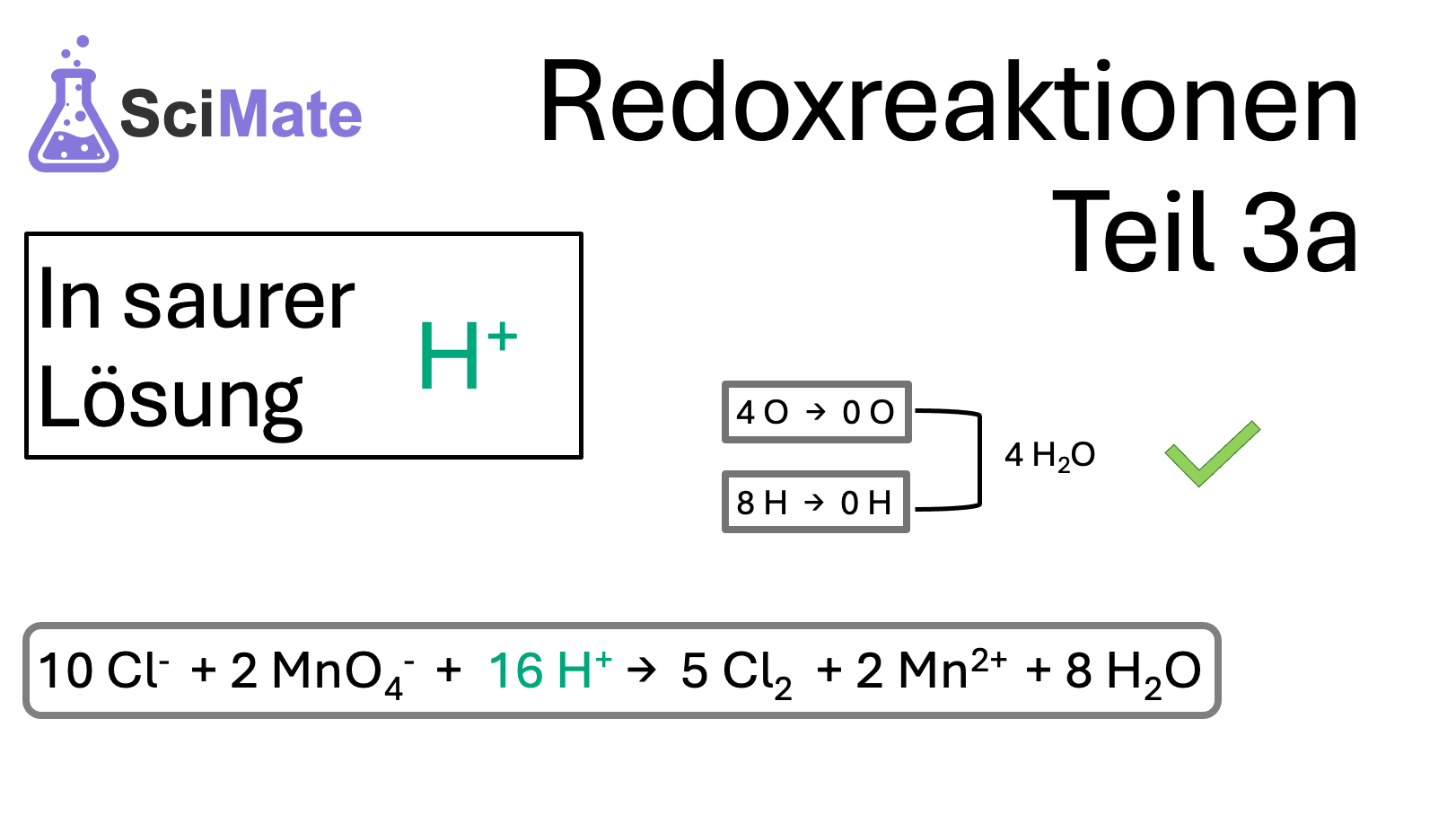
2 MnO₄⁻ + 10 Cl⁻ + 16 H⁺ → 2 Mn²⁺ + 5 Cl₂ + 8 H₂O
Step 5 – Cancel out & Check:
Nothing more can be cancelled out. Check: 2 Mn ✓ | 10 Cl ✓ | 8 O ✓ | 16 H ✓ | Charge on left: −12 + 16 = +4 | Charge on right: +4 ✓
Part 4: Redox Reactions in Basic Solution
In a basic solution, OH⁻ ions are available in excess. The procedure is very similar to that in an acidic solution – except that instead of H⁺, H₂O molecules and OH⁻ ions are used for mass balancing. During the final simplification, H₂O and OH⁻ on both sides often cancel each other out.
Procedure: Half-Reaction Method (Basic Solution)
- Determine the oxidation states of all elements and highlight the changes.
-
For each half-reaction:
- Write down the half-reactions (enter only the reacting substances).
- Charge balancing: Write electrons on the more positive side.
- Mass balancing: Supplement O atoms with H₂O, and H atoms with OH⁻ from the basic solution.
- Balance the electrons: Multiply the half-reactions by the least common multiple (LCM) of the electron counts.
- Combine: Add both half-reactions together.
- Cancel out: Cross out identical terms on both sides (H₂O, OH⁻) and check the balance.
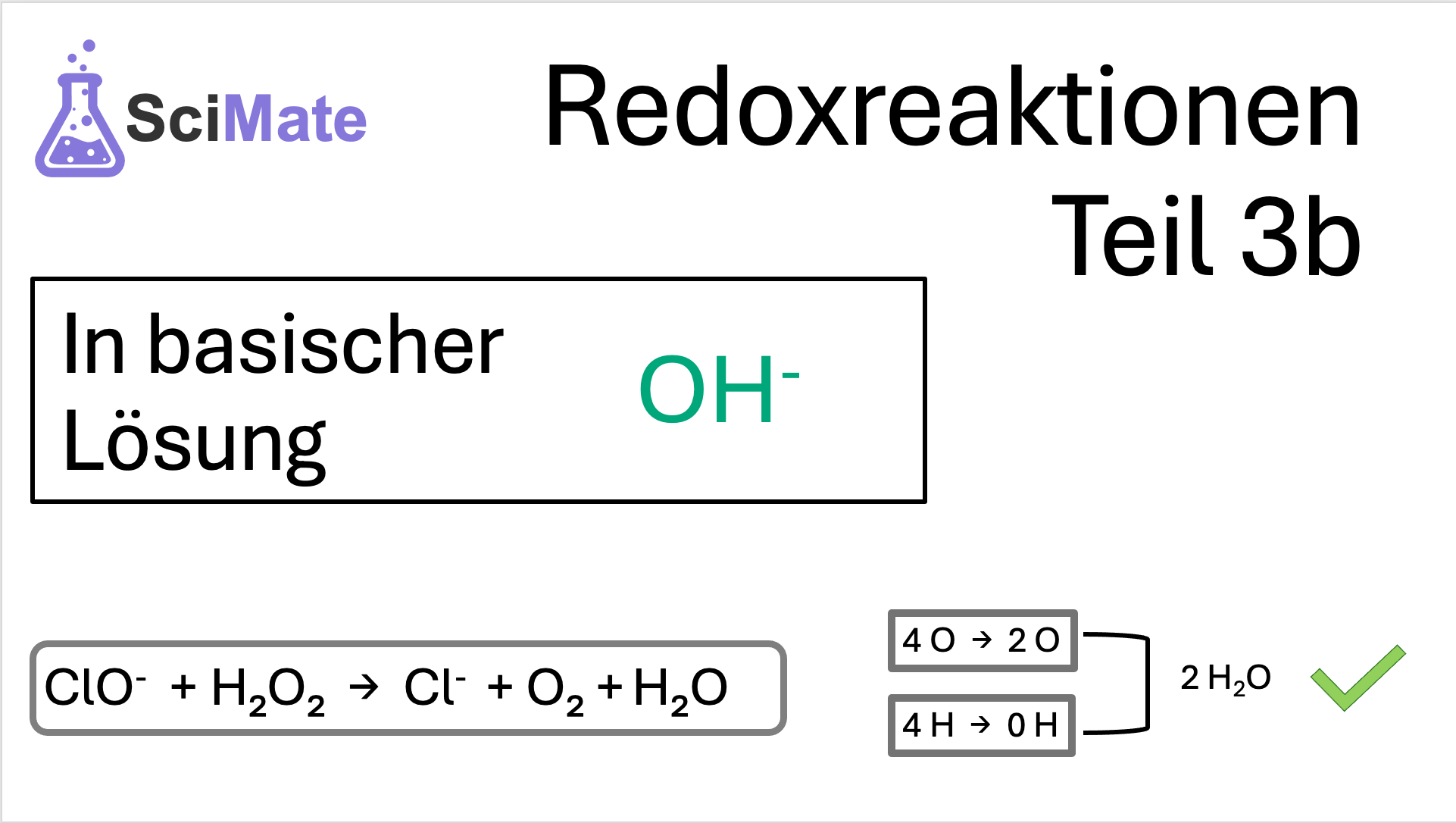
Example: ClO⁻ + H₂O₂ in Basic Solution
In a basic solution, hypochlorite (ClO⁻) reacts with hydrogen peroxide (H₂O₂). The Cl in ClO⁻ is reduced (+1 → −1), and the O in H₂O₂ is oxidized (−1 → 0, forming O₂). Unbalanced equation: ClO⁻ + H₂O₂ → Cl⁻ + O₂
Determine the oxidation states of all elements and highlight the changes.
ClO⁻: O has −2, so OS(Cl) = +1 (since +1 + (−2) = −1 = ionic charge). H₂O₂: H has +1, so OS(O) = −1 (since 2·(+1) + 2·(−1) = 0). In the product: Cl⁻ = −1, O₂ = 0.
Step 2a – Write down the half-reactions:
Reduction (ClO⁻): ClO⁻ → Cl⁻
Oxidation (H₂O₂): H₂O₂ → O₂
Step 2b – Charge balancing:
Reduction (ClO⁻): ClO⁻ + 2 e⁻ → Cl⁻
Cl goes from +1 to −1: Difference = 2. Thus, Cl gains 2 e⁻. Charge on left: −1. Charge on right: −1. With 2 e⁻ on the left side: −1 + (−2) = −3 ≠ −1. Correction: 2 e⁻ on the left side makes −3, right side is −1 → not yet balanced, mass balancing will bring it into equilibrium.
Oxidation (H₂O₂): H₂O₂ → O₂ + 2 e⁻
O goes from −1 to 0 per atom: Difference = 1. With 2 O atoms in H₂O₂, a total of 2 e⁻ are lost.
Step 2c – Mass balancing:
Reduction (ClO⁻): ClO⁻ + H₂O + 2 e⁻ → Cl⁻ + 2 OH⁻
Left: 1 O from ClO⁻ must be bound → add 1 H₂O (left). This creates 2 H on the left side → add 2 OH⁻ to the right side (basic solution). Charge check: left −1 + (−2) = −3 | right −1 + 2·(−1) = −3 ✓
Oxidation (H₂O₂): H₂O₂ + 2 OH⁻ → O₂ + 2 H₂O + 2 e⁻
Left: Add 2 OH⁻ to bind the H atoms from H₂O₂. Right: 2 H₂O are formed. Charge check: left 0 + 2·(−1) = −2 | right 0 + 0 + (−2) = −2 ✓
Step 3 – Balance the electrons:
Both half-reactions transfer 2 electrons each – the least common multiple (LCM) is 2. Since both already have 2 e⁻, they can be added directly (factor 1 × 1):
1 · (ClO⁻ + H₂O + 2 e⁻ → Cl⁻ + 2 OH⁻)
1 · (H₂O₂ + 2 OH⁻ → O₂ + 2 H₂O + 2 e⁻)
Step 4 – Combine (before cancelling out):
ClO⁻ + H₂O + H₂O₂ + 2 OH⁻ → Cl⁻ + 2 OH⁻ + O₂ + 2 H₂O
Step 5 – Cancel out & Check:
ClO⁻ + H₂O₂ → Cl⁻ + O₂ + H₂O
After cancelling out: 1 H₂O left and 2 H₂O right → net 1 H₂O right. 2 OH⁻ on both sides cancel each other out. Check: 1 Cl ✓ | 3 O left (1+2) and 3 O right (2+1) ✓ | Charge: −1 left and −1 right ✓