Dilution Calculator & Mixing Calculator
Calculate concentration or volume when diluting and mixing solutions using the dilution formula c₁·V₁ = c₂·V₂. The calculator determines c₁, c₂, V₁, or V₂ automatically.
Dilution Calculator
Are you instead looking for just the concentration, amount of substance, mass, or volume of a single solution? Go to the Concentration Calculator.
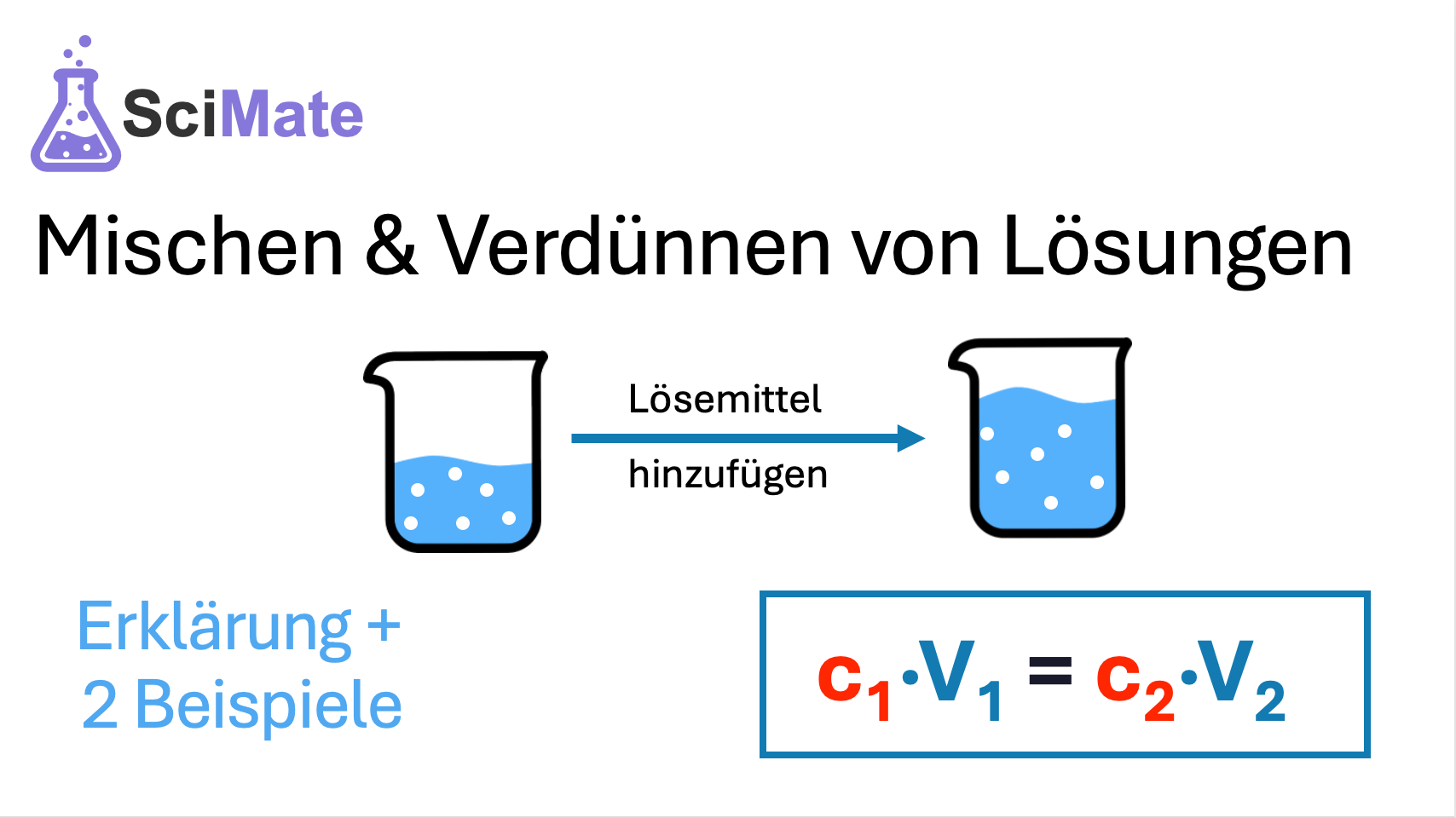
How does diluting and mixing work?
What happens during dilution and mixing?
If you pour water into a salt solution, it becomes more dilute – the amount of salt remains the same, but the volume increases. If you let water evaporate, the solution becomes more concentrated because the same amount of salt is now in a smaller volume.
In both cases, it is not the amount of dissolved substance that changes, but rather the ratio of the amount of substance to the volume – i.e., the concentration. This exact relationship is represented by the formula c₁·V₁ = c₂·V₂.
An overview of the four variables
Initial concentration (c₁)
The concentration of the solution before you dilute or mix.
Initial volume (V₁)
The volume of the solution with the initial concentration c₁.
Target concentration (c₂)
The concentration that the solution should have after diluting or concentrating.
Target volume (V₂)
The total volume of the solution after it has been adjusted to the target concentration.
Since the amount of substance n remains constant during dilution, n = c₁·V₁ = c₂·V₂ applies. If you know three of the four variables c₁, V₁, c₂, and V₂, the fourth can be calculated directly.
The Formula: c₁ · V₁ = c₂ · V₂
This formula describes that the amount of substance remains the same before and after diluting or mixing.
Basic Formula
c₁ · V₁ = c₂ · V₂
Whether you add water (dilution) or remove water (concentration) – as long as no dissolved substance is added or removed, this relationship holds true.
Rearranging for any of the four variables
Since four variables are in one equation, you can solve for each one individually as soon as the other three are known.
Calculating the initial volume (finding V₁)
V₁ = (c₂ · V₂) / c₁
Used when you want to know how much concentrated initial solution you need for a specific target concentration and target volume.
Calculating the initial concentration (finding c₁)
c₁ = (c₂ · V₂) / V₁
Used when you want to check the minimum concentration your initial solution needs to be.
Calculating the target volume (finding V₂)
V₂ = (c₁ · V₁) / c₂
The most common application: You have a concentrated solution and want to know to what volume you must dilute it to reach a specific target concentration.
Calculating the target concentration (finding c₂)
c₂ = (c₁ · V₁) / V₂
Used when you want to know what concentration is achieved when you bring a certain amount of solution to a specific volume.
Pay attention to the units
c₁ and c₂ must be in the same concentration unit (both mol/l or both g/l), and V₁ and V₂ must be in the same unit of volume. Otherwise, your result will be incorrect.
When molar and mass concentrations are mixed
mischungsrechner_erklärtext_umrechnung_einleitung
mischungsrechner_erklärtext_umrechnung_definitionen
- mischungsrechner_erklärtext_umrechnung_cmol
cmol = n / V(mol/l) - mischungsrechner_erklärtext_umrechnung_cm
cm = m / V(g/l)
mischungsrechner_erklärtext_umrechnung_molaremasse M mischungsrechner_erklärtext_umrechnung_gilt
$$c_m = c_{\text{mol}} \cdot M$$
$$c_{\text{mol}} = \dfrac{c_m}{M}$$
mischungsrechner_erklärtext_umrechnung_hinweis
Calculation Examples
The following examples show the four typical use cases: dilution, concentration, and handling mass specifications.
Example 1 – How much stock solution is required?
You are asked to prepare 500 ml of a 0.5 mol/l solution from a 2 mol/l NaCl stock solution. How much stock solution do you need?
Given
c₁ = 2 mol/l, c₂ = 0.5 mol/l, V₂ = 500 ml = 0.5 l
Required
V₁ = ?
Solution
$$ V_1 = \dfrac{c_2 \cdot V_2}{c_1} $$
$$ V_1 = \dfrac{0.5\ \frac{\text{mol}}{\text{l}} \cdot 0.5\ \text{l}}{2\ \frac{\text{mol}}{\text{l}}} $$
V₁ = 0.125 l = 125 ml. So you take 125 ml of the stock solution and fill it up to 500 ml with water.
Example 2 – To what concentration do you dilute?
You dilute 20 ml of a 5 mol/l acetic acid solution with water to a total volume of 200 ml. What is the concentration of the diluted solution?
Given
c₁ = 5 mol/l, V₁ = 20 ml, V₂ = 200 ml
Required
c₂ = ?
Solution
$$ c_2 = \dfrac{c_1 \cdot V_1}{V_2} $$
$$ c_2 = \dfrac{5\ \frac{\text{mol}}{\text{l}} \cdot 20\ \text{ml}}{200\ \text{ml}} $$
c₂ = 0.5 mol/l
Example 3 – Concentrating by evaporation
A solution with a volume of 1 l and a concentration of 0.2 mol/l is to be concentrated to 0.8 mol/l by evaporating water. To what volume must it be evaporated?
Given
c₁ = 0.2 mol/l, V₁ = 1 l, c₂ = 0.8 mol/l
Required
V₂ = ?
Solution
$$ V_2 = \dfrac{c_1 \cdot V_1}{c_2} $$
$$ V_2 = \dfrac{0.2\ \frac{\text{mol}}{\text{l}} \cdot 1\ \text{l}}{0.8\ \frac{\text{mol}}{\text{l}}} $$
V₂ = 0.25 l = 250 ml. Therefore, 750 ml of water must be evaporated.
Example 4 – Dilution with mass concentration
An NaCl solution with c₁ = 10 g/l is to be diluted to c₂ = 0.171 mol/l. How many ml of the initial solution are required for a target volume of 100 ml?
Given
c₁ = 10 g/l, M(NaCl) = 58.44 g/mol, c₂ = 0.171 mol/l, V₂ = 100 ml
Step 1 – Convert c₁ to mol/l
$$ c_{1,\text{mol}} = \dfrac{10\ \frac{\text{g}}{\text{l}}}{58.44\ \frac{\text{g}}{\text{mol}}} \approx 0.171\ \frac{\text{mol}}{\text{l}} $$
Step 2 – Calculate V₁
$$ V_1 = \dfrac{c_2 \cdot V_2}{c_{1,\text{mol}}} $$
$$ V_1 = \dfrac{0.171\ \frac{\text{mol}}{\text{l}} \cdot 100\ \text{ml}}{0.171\ \frac{\text{mol}}{\text{l}}} $$
V₁ ≈ 100 ml. Since c₁ and c₂ are equal in this example, no dilution is necessary – the example mainly shows the conversion between g/l and mol/l.
Tips and Common Mistakes
Common Mistakes when Diluting and Mixing
1. Mixing different units of concentration
Plugging c₁ in mol/l and c₂ in g/l directly into the formula leads to incorrect results. First convert both to the same unit, using the molar mass M if necessary.
2. Volume units not matched
Plugging V₁ in ml and V₂ in l in together changes your result by a factor of 1000. Convert both volumes to the same unit before calculating.
3. Confusing target volume with added volume
V₂ is the total volume of the finished solution, not the amount of water you add additionally. If you want to know how much water is added, you must subtract V₁ from V₂.
4. Confusing dilution with mixing two different solutions
c₁·V₁ = c₂·V₂ only applies when you dilute a solution with pure solvent or concentrate it by evaporation. If two solutions of the same substance with different concentrations are mixed together, you must instead add the amounts of substance of both solutions: n_total = c₁·V₁ + c₂·V₂.
The fastest way to proceed
First write down which three of the four variables c₁, V₁, c₂, V₂ are given. Check whether both concentrations and both volumes have the same unit, and convert if necessary before substituting.
Where do you encounter dilution and mixing in everyday life and in the laboratory?
The formula c₁·V₁ = c₂·V₂ is one of the most frequently used formulas in the laboratory and in practice:
- Preparation of dilution series in chemistry and biology laboratories
- Diluting disinfectants and cleaning concentrates to working concentration
- Dosing of medications, e.g., diluting injection solutions
- Production of food and beverages, e.g., diluting syrup or fruit juice concentrate